
Hope is a Promise
As well as a weapon and a tool we can use to help us resist, while building a better future.


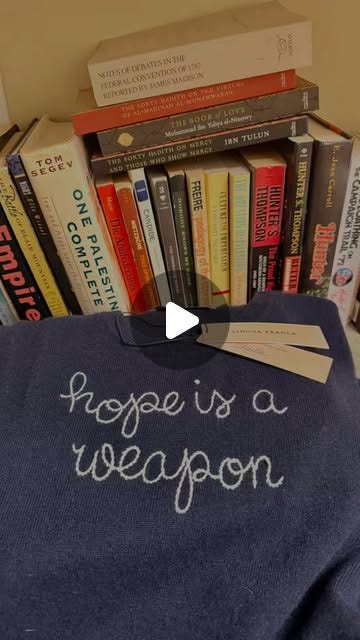
Hope is a powerful human emotion, feeling, and expectation capable of providing our lives with greater meaning. It’s also been described as a weapon, a blade and a shield for us to wield as we resist injustice.
A friend recently shared the following video with me from writer, songwriter, and storyteller Robert L Arnold. Take a moment to listen before reading on.
She shared it with me after the Kansas legislature - composed of a GOP supermajority dominated by its MAGA, white supremacist leadership - voted to override our governor’s veto of the equal parts cruel, ludicrous, and costly bathroom / gender marker bill. And this was the bill that tipped the scales for Erin Reed, shifting Kansas to the do not travel category, putting us in the elite company of Texas and Florida, above that of even Missouri and Iowa.
It was frustrating to watch the legislature pass the bill initially and then subsequently override the governor’s veto after cutting debate short, with many smirking along the way. It was disheartening to have Republicans who knew better tell me they couldn’t stand up to their leadership. It was infuriating to have Republicans tell me, after laying out the human and fiscal impacts (to all Kansans) of this legislation, after appealing to whatever sense of curiosity they might have regarding the realities of sex and gender, after pleading with them as a parent, after all of that to then actually tell me my son is mentally ill, that he doesn’t matter because trans people are such a small percentage, or that they just don’t agree with me (or the overwhelming amount of opponent testimony submitted by Kansans, experts, and the LGBTQ+ community) but to nevertheless have a good day anyway.
My anger only increased last week when the Kansas Division of Vehicles began sending out letters to transgender individuals letting them know their driver’s license was no longer valid. It’s so enraging - this senseless cruelty that is itself the point (though the first lawsuit has been filed). As far as I’m concerned these legislators can have the fucking day they deserve.
My friend sensed my anger, frustration, and concern. It’s why she shared the video with me. And in sharing Robert L Arnold’s video, she was reminding me that kindness still exists in the quiet spaces, that people still show up when you’re trying to make something better, and sometimes hope reappears in unexpected forms.
It’s true. I recall the kindness of another friend who hugged me last year at the Capitol, expressing solidarity and empathy. People are also protesting and submitting gobs of opponent testimony (and now submitting lawsuits), not to mention all of the Democrats in the legislature constantly showing up to do what they can to resist (and set the stage for breaking the supermajority). And there’s the hope of my son - still expressing compassion for those Republicans voting for this out of fear - that their conscience will at some point be the seed that grows into a spine.
Arnold’s expression of gratitude above is a follow up to an earlier, longer video he made discussing hope as a weapon. You can view it here.
I understand the choice of language, of describing hope as a weapon, of using the language of war and armed conflict. Because there’s much requiring our active resistance and various forms of individual and collective action. Words of war, even if not being used literally, can help rouse us off our couches to peacefully resist against:
Support of the Trump regime’s brutal, inhumane, deadly, authoritarian, and unconstitutional immigration policies enforced by the actions of ICE and the CBP, including support of efforts to obtain maximum cooperation from local and state law enforcement in these unlawful federal actions.
Equating biological sex with gender, claiming there are only males and females, and claiming the white Christian nationalist very narrow definition of family and marriage forms the moral foundation of society, while denying the realities of, and overwhelming evidence for, the complexities of the entangled sex / gender spectrum. Then using this to justify eliminating same sex marriage and erasing the transgender, non-binary, and intersex communities.
Telling women their bodies are not their own, and declaring the lives of children only really matter while they’re still in the womb - once they’re born they best start figuring out how to make it on their own. People need to pull themselves up by their own bootstraps, even if those boots are only toddler-sized.
Decreasing access to affordable healthcare, with real negative consequences to our poorest citizens, rural communities, and even our veterans, by focusing on for-profit healthcare solutions and refraining from expanding Medicaid and other federal healthcare programs - to enrich corporate administrators, lobbyists, and the legislators in their pockets.
Promoting limited and regressive (flat) taxes that starve government, public services, and social safety nets while increasing privatization and the associated private capture of revenue streams, all of which continues shifting money upward, further increasing the wealth gap, while also stigmatizing the poor in the process.
Defunding / underfunding public education, forcing unfunded mandates on school districts, disrespecting teachers as autonomous professionals, using culture war issues to attack both public education and vulnerable minorities, and stripping control away from local school boards.
Promoting the arming of teachers - forcing them to act as law enforcement and shields against the bullets aimed at ripping through the bodies of their students - instead of addressing the underlying causes of mass shootings, including ineffective gun control legislation.
Denying the realities of, and the overwhelming evidence for, anthropogenic climate change and the impacts of greenhouse gases on our ability to flourish as a species. This denial is necessary to support the fossil fuel and chemical industries while standing in the way of efforts to rapidly decarbonize society. This includes everything from subsidizing fossil fuels (and undermining the market’s favoring of renewables), to stripping municipalities of their ability to restrict the use of natural gas in new construction, to preventing the adoption of codes requiring various sustainable and regenerative measures for our built environment.
Adopting direct elections of state Supreme Court Justices and judges statewide to make them partisan and help ensure minority rule by the most extreme part of the GOP / MAGA party, and
Supporting the myth of rampant voter fraud (the myth is the real fraud) to disenfranchise voters - through such things as purging voter roles, restricting the use of mail-in ballots, reducing the time for early voting, requiring the use of a government-issued photo IDs to vote, supporting the deployment of ICE and CBP at the polls, etc. - to also help ensure minority rule by the most extreme part of the GOP / MAGA party.
Note that each and every one of these items are part of the Kansas Republican Party platform adopted on January 31, 2026. I may have added some interpretations not explicitly stated in the document, but they are there nonetheless if you read between the lines, taking legislative actions and words into account. You can also find these and other bigoted, regressive, racist, fascist, white supremacist, and authoritarian goals in the GOP party platforms and actions of other states as well as in Congress and, of course, Trump’s executive branch. They’re woven throughout Project 2025 and Project 2026, including the dismantling of representative democracy within the U.S.
So yeah, the language of war and conflict, in addition to being an effective call to action, can also just feel good to utter when you’re really angry about all of this (with some profanity thrown in for good measure). But the language of conflict isn’t always enough for everyone. Nor is it really sustaining - intense, fiery emotions require a lot of fuel to keep raging before burning out, before burning you out. It also exacerbates the othering that occurs with respect to those you’re struggling against, contributes to dehumanizing them, and reduces the curiosity we need to understand the other side (and ultimately undermine their harmful ideologies as we hold them accountable).
And so, is it enough for hope to be a weapon?
What is hope, exactly? Merriam-Webster defines it as a desire accompanied by expectation of obtaining what is desired or belief that it is obtainable; an expectation of fulfillment or success. It’s basically an expectation of successfully achieving a desired goal. Clinical psychologist Anthony Scioli put it another way, stating [h]ope is best viewed as an ameliorating emotion, designed to fill the liminal space between need and reality.
And research (summarized here) has shown that, as part of the human condition, it goes beyond this simple expectation or filling of liminal space. As I stated earlier, hope and the positive feelings associated with it have been found to give our lives meaning, particularly by increasing our perceptions of purpose, coherence, and significance, and particularly during difficult times. Feelings of hope are also intertwined with degrees of social support, strong social networks, and a sense of belonging - there are both individual and social experiences of hope.
But at the heart of all this does lie the desired goal(s), vision(s), and need(s). And one could argue that the more concrete they are, the stronger, more inspiring, and more sustainable are the associated feelings of hope.
This is one reason why hope is a weapon often works (at least initially). Resisting something - fighting against something - is concrete; the associated steps and actions are relatively easy to define and there’s a more easily defined end result. The associated emotions are also primed to bring people together and generate action. But if these immediate goals are reached, then what? If people burn out, then what?
Hope must be more than a weapon of resistance, pushing us away from bigotry, racism, fascism, white supremacy, white Christian nationalism, and authoritarianism. It must also pull us toward a vision of a more socially and environmentally just, democratic society. And we can use hope to help us build that society - as such, hope then becomes more than a weapon, it’s more broadly a tool (as Arnold also mentioned). And it’s a promise we make to ourselves that we’ll not just resist and fight, but also come together to build a better society.
To do that, though, the goals and vision of a better society need to be more concrete, something that arguably needs significantly more effort spent doing and communicating.
I think the Kansas Democratic Party platform portrays a vision of our state (and the world) that is significantly more socially and environmentally just, more beneficial to us all, than the Republican Party platform. But it’s not a roadmap of how to get there - it’s not full of concrete actions to overcome misinformation and disinformation, to undermine the current elite capture of society, or to remake our socially constructed free-market economic system (currently rooted in the neoclassical economic paradigm), all of which greatly constrain achieving the platform’s vision, and even corrupt individuals and groups within the Democratic party itself (as well as other parties).
Without some idea of the path(s) forward, what are we promising ourselves to build together? What are we hoping for? We need some place to start, even if we recognize we’ll be building the plane as we’re flying it. So, here’s one potential path forward.
What if we started with some basic, guiding principles related to aspects of individual and collective human behavior? Something like political scientist/sociologist and Nobel Economics prize winner Elinor Ostrom’s core design principles (CDPs) of cooperation. These principles, common to our species, evolved among our ancestors who lived in small groups, primarily as a means to protect access (within and between groups) to a variety of common pool resources. But, as it turns out, they’re beneficial for the cooperation of achieving any goal, and I’ve written about them in more detail here and here.
ProSocial.World, supercharging Ostrom's work by combining it with cultural multi-level selection (CMLS), an extension of general evolutionary theory, and Acceptance and Commitment Therapy (ACT), developed a process to help the members of groups and organizations (regardless of type and size) cooperate in achieving prosocial goals. The CDPs, once successfully implemented, act as a sort of inoculation against behaviors, decisions, actions, etc., that undermine the group, from wealth gaps and inequitable access to resources to bigotry and the undermining of democracy. Using the language of evolutionary theory, they select for prosocial behaviors. And they’re most effective when we mindfully assess how to best implement them for the scale, location, and group in question, as well as monitor and adjust that implementation over the long term.
I’ve previously written about applying the CDPs to human-centered and integrated design approaches (here), as well to the AEC Industry as a whole (here and here), and even to government (here and here). Bipartisan and/or prosocial governing actions, such as the Kansas legislature passing a conservation funding bill out of committee, Congress saving ENERGY STAR from the chopping block, or the European Parliament's recognition of trans women as women, occur because at least some of the CDPs are actively at work, whether intentional or not.
The mission of economist Mariana Mazzucato to re-envision and recreate global economic systems based on equity and the common good, as well Kate Raworth’s Doughnut Economics model of achieving human prosperity within planetary boundaries, replacing the goal of endless growth with a safe and just space for humanity, both integrate the CDPs (though I don’t believe that was explicitly intended). Shifting back down to the local scale, Daniel T. O’Brien’s work also indirectly touches on the CDPs, focusing on how the environment at the scales of neighborhoods, streets, and individual addresses impacts our quality of life and behaviors, and how city policy changes (changing the social environment), which in turn also changes the physical environment, can prosocially improve things.
Understanding how to contextually implement the CDPs requires engaging and understanding the people impacted. Anthropologists, sociologists, ethnographic methods, and other aspects of the behavioral sciences are really important for this. Robert Leonard’s and Jason Walsmith’s series, Portraits of Hunger in Iowa, is an example of listening directly to the people impacted, hearing their stories, and giving them a voice. Such efforts, along with more academic efforts like the work by Alice Evans, begin to generate the understanding necessary to co-create prosocial policies with those directly impacted, rooted in the CDPs, that actually address the challenges society faces.
And our young people really need a vision for the future; hell, they need a vision where they have a future. And they need to be part of creating that vision as well as the road map for how to get there. They need to be part of creating these contextual implementations of the CDPs, as well as their long-term monitoring and subsequent adjustments. They need to be part of the promise we’re making ourselves to come together to build a better society - to build a future for them and their children. They need hope, and I’ve found Matt Russell’s Growing New Leaders: Perspectives from Coyote Run Farm substack and Anya Kamenetz’s The Golden Hour: climate, children, mental health substack both insightful in understanding, embracing, and including the next generation.
Finally, a recent book by Michael Brownstein, Alex Madva, and Daniel Kelly - Somebody Should Do Something: How Anyone Can Help Create Social Change, ties a lot of this together while indirectly touching on the CDPs, focusing on how individual and collective actions are intertwined in their efforts to create change, while also acknowledging the importance of the physical and social environment.
Do the CDPs, and this particular outline, represent the best way to build a concrete vision, set of goals, and associated road map to get there, to provide a vision we can promise to build together? Can it help generate the hope necessary to sustain us over the long haul of creation after the resistance is done? Maybe not, and there’s certainly significantly more details and smarter people than me needed to map everything out, but because all of this recognizes and acts on key realities of the human condition, it could be a good place to start…
It could be a good place to start building our promise of a socially and environmentally just future as we resist the hate and bigotry of MAGA-controlled state legislatures and a fascist, authoritarian regime conducting illegal military actions, brutalizing its own citizens, and bent on destroying democracy. It could help fill the liminal space between need and reality and, in the process, add necessary meaning to our lives. It could do this because…
Hope is a weapon, a tool, and a promise.
I filled a page of notes and will be rereading and rereading this post. Thank you for HOPE and all of the accompanying references. Necessary reading and subsequent actions.
There are still some campfires burning